Download The Portuguese Massacre of Wiriyamu in Colonial Mozambique, 1964-2013
A book is much related to reviewing tasks. Book will certainly be nothing when none reviews it. Reviewing will certainly not be completed when the book is among the subjects. Nevertheless, in this contemporary era, the presence of book is expanding sophisticatedly. Numerous sources make the both book in published as well as soft documents. Having the soft file of publication will certainly ease you to make real to read it. It can be saved in your various device, computer system, CD, laptop, also the device that you constantly bring almost everywhere. It is why; we show you the soft file of The Portuguese Massacre Of Wiriyamu In Colonial Mozambique, 1964-2013 as one of issue to read.
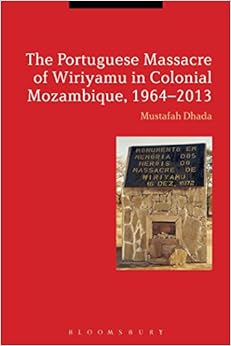
The Portuguese Massacre of Wiriyamu in Colonial Mozambique, 1964-2013

Download The Portuguese Massacre of Wiriyamu in Colonial Mozambique, 1964-2013
Is The Portuguese Massacre Of Wiriyamu In Colonial Mozambique, 1964-2013 publication your favourite reading? Is fictions? Exactly how's about record? Or is the very best vendor novel your selection to satisfy your leisure? Or perhaps the politic or spiritual books are you hunting for now? Right here we go we provide The Portuguese Massacre Of Wiriyamu In Colonial Mozambique, 1964-2013 book collections that you need. Bunches of numbers of books from many industries are offered. From fictions to scientific research as well as religious can be browsed and also discovered right here. You might not worry not to find your referred book to read. This The Portuguese Massacre Of Wiriyamu In Colonial Mozambique, 1964-2013 is among them.
Reading is really a should and this is extremely important in this life. When someone reads lots, just make manage your personal idea, exactly what concerning you? When will you begin to read whole lots? Many individuals constantly try to utilize their time [perfectly to read. A book that becomes reading materials will certainly come to be buddies when they remain in lonesome. The The Portuguese Massacre Of Wiriyamu In Colonial Mozambique, 1964-2013 that we have actually supplied here will refer to the fantastic way and reference that can set good life.
Currently, we need to inform you little aspect of the information related to the The Portuguese Massacre Of Wiriyamu In Colonial Mozambique, 1964-2013 When you truly have such specific time to prepare something or have the spare time to read a book choose this. This is not only suggested for you. This is likewise recommended for all people on the planet. So, when you feel love in this book, quicker get it or you will certainly be left of others. This is just what we will certainly tell to you regarding the factor you need to get it asap, only in this website.
Collect the book The Portuguese Massacre Of Wiriyamu In Colonial Mozambique, 1964-2013 start from now. Yet the brand-new means is by gathering the soft data of the book The Portuguese Massacre Of Wiriyamu In Colonial Mozambique, 1964-2013 Taking the soft file can be conserved or stored in computer system or in your laptop computer. So, it can be more than a book The Portuguese Massacre Of Wiriyamu In Colonial Mozambique, 1964-2013 that you have. The simplest way to expose is that you can likewise save the soft file of The Portuguese Massacre Of Wiriyamu In Colonial Mozambique, 1964-2013 in your ideal as well as offered gizmo. This problem will certainly expect you too often read The Portuguese Massacre Of Wiriyamu In Colonial Mozambique, 1964-2013 in the spare times more than chatting or gossiping. It will certainly not make you have bad habit, however it will lead you to have far better habit to read book The Portuguese Massacre Of Wiriyamu In Colonial Mozambique, 1964-2013.
Review
“The result of a decade of scrupulous and original research, [this book] is a precious contribution to the history of Portuguese late colonialism … Dhada’s work both expands and perfects historical knowledge and method. It serves as a powerful corrective to old and contemporary mystifications about the colonial modi operandi … Its content clearly exposes the previous flawed accounts, revealing their superficial, speculative, and second-rate research.†– American Historical Review“While he has assiduously made his way through a mass of archival and other written sources, the pre-eminent original contribution of this book is the material gathered from interviews with survivors of the killings and others who had been in and around Wiriyamu at the time. These include a perpetrator who, penitent in the decades after the event, provides testimony that strengthens the case for official culpability.†– English Historical Review“Mustafah Dhada’s important and idiosyncratic book … [is an] essential document that provides extensive lists of sources, records of census results and of the recovered names of the victims, and a roster of the individuals who provided personal testimony about one of the worst atrocities of the liberation war in Mozambique." - The International Journal of African Historical Studies“The book is written in engaging and accessible prose … [A] valuable addition to the history of war and counterinsurgency in Mozambique … Dhada has written an indispensable account of the Mozambican war for independence.†- Journal of Military History
Read more
About the Author
Mustafah Dhada is Professor of History at California State University, Bakersfield, USA, and Research Associate at the Center for Social Studies, Coimbra University, Portugal. He is the author of Warriors at Work (1993).Peter Pringle is a foreign correspondent, investigative reporter and writer. He is the co-author of Those Are Real Bullets: Bloody Sunday, Derry, 1972 (2000).
Read more
Product details
Paperback: 256 pages
Publisher: Bloomsbury Academic; Reprint edition (May 18, 2017)
Language: English
ISBN-10: 9781350036802
ISBN-13: 978-1350036802
ASIN: 1350036803
Product Dimensions:
6.1 x 0.5 x 9.2 inches
Shipping Weight: 13 ounces (View shipping rates and policies)
Average Customer Review:
5.0 out of 5 stars
8 customer reviews
Amazon Best Sellers Rank:
#538,323 in Books (See Top 100 in Books)
Mustafah Dhada’s book, The Portuguese Massacre of Wiriyamu in Colonial Mozambique, 1964-2013, is the story of five villages that were doomed to destruction by forces bigger than they could ever imagine. The book begins with a short introduction that begins to explain to its readers why this village of Wiriyamu, that most have not heard of prior to reading this book, is so important to colonial history, and to Dhada. The book has many things working in its favor. The author used his intellectual strength to pursue the best method for collecting the data needed to uncover the whole story of what happened at Wiriyamu. He was able to use everything he learned to create a working field plan, which after some minor glitches proved to do what it was meant to do. The author read extensively into the atrocities committed and the denials of those atrocities and deemed it possible to step outside the situation and investigate the details of the case impartial to what he had previously learned. He takes the story apart from several angles. He catches the important events that led to the uprising, the involvement of each participant and why they were involved. He shows the acts committed by the Portuguese that were intended to relieve headaches, which ironically created more problems for the imperial government, and he includes the sheer number of coincidence involved in the release of the story to the media.More than just the great amount of information contained in the book, the style of writing is a major improvement over history narratives in general. This book is written like a murder mystery. One already knows who the culprit is at the beginning, but still the unveiling of the assassinations committed is at points riveting. Most students would agree, no matter how much one loves the subject of history, the text involved can be excruciatingly boring and close to painful if one has to read them for any significant length of time. Dhada’s book does not have that effect, it is written to pique the interest of the reader and keep the pages turning. That being said, the book does have a few failures in the way of completely informing the readers. One issue with the book is that from the very first pages the reader can understand that the author has an agenda. His agenda was to expose the Portuguese for the crimes they committed against their colonies, specifically the colony of Mozambique. He has a vested interest, as he explains, he once lived inside that very colony under the authority of the government he wishes to expose. This makes the assertion of this being only the facts, and an unbiased story suspect. During the process of going through he different areas of the story one can pull out a few passages that are clearly written with some bias. Some are not very important to the narrative of the story while other instances cause the complete picture to become a bit murky.This texts contribution to the historical genre is stand alone as far as this reader can tell. The book is more a work of a detective novel unraveling all the details that lead to the apprehension of a killer than a historical work, though it is a historical text in essence. The work should be seen as a model for how future historical texts are written as first-hand knowledge and passion for a subject are bound to engage the scholar in a way that no previous text has been able to do, creating a new learning environment for the new kind of student learning to study and create historical texts.
Dr. Dhada’s text is not only informative, but carefully crafted in an intriguing way, so much so that as a reader, I am never bored. The poetic text veers from a bland narrative to one that keeps me emotional and on my toes, wanting to piece all of the research together and see it in the light being presented. The research methods used and the details presented not only give readers information already present in history (though, little it may be if at all), but also new information extracted directly from participants on all sides of the massacre. It has added to the narrative, giving readers the opportunity to view history from the bottom to the top for a change. In all, I truly enjoy reading the time and effort put into this text, and it seems to be I am not the only one who sees it that way!
Few historical works have been emotional reads for me, however Dhada’s is one of them. European imperialism resulted in the massacres of many indigenous people and the Portuguese Empire is no exception. In the 60s, the Portuguese, under the leadership of Salazar and then Caetano, attempted to suppress a group of freedom fighters in Mozambique known as Frelimo. The colonial secret police (DGS) in Mozambique engaged in brutal tactics to suppress the organization including imprisonment and murder. On December 16, 1972, the DGS ambushed the tiny village of Wiriyamu, killing at least 400 men, women, and children in unspeakable ways. Dhada warns early in his work that the narrative of the massacre is not for the faint of heart and the account is truly gut-wrenching. Furthermore, the Portuguese and colonial government attempted to erase the massacre as well as the village from existence in an extensive cover up. Due to the efforts of priests within Mozambique who catalogued and recorded evidence, news of the massacre was smuggled out of the country. Much of this news was then brought to international attention by father Adrian Hastings and reporter Peter Pringle.Today, the massacre remains a sensitive topic among the Portuguese, yet its evidence is clear and Dhada’s work excels in laying it bare. The first portion of his work describes the extensive manner in which evidence for this work was collected. Although Dhada recommends that those simply interested in the narrative proceed to later chapters, I would advise all interested in the gathering of evidence for a historical work to disregard such advice and read. As a history student, his description of his process for collecting evidence, especially from oral sources was fascinating and extremely helpful. Furthermore, his interviews bring out the humanity of the victims. Those massacred in Wiriyamu were not statistics, they were mothers and fathers going about their daily work preparing for a celebration of rain; they are brothers and sons tending their cattle; they are children at play.Dhada’s work is thoroughly researched and highly readable.
The Portuguese Massacre of Wiriyamu in Colonial Mozambique, 1964-2013 PDF
The Portuguese Massacre of Wiriyamu in Colonial Mozambique, 1964-2013 EPub
The Portuguese Massacre of Wiriyamu in Colonial Mozambique, 1964-2013 Doc
The Portuguese Massacre of Wiriyamu in Colonial Mozambique, 1964-2013 iBooks
The Portuguese Massacre of Wiriyamu in Colonial Mozambique, 1964-2013 rtf
The Portuguese Massacre of Wiriyamu in Colonial Mozambique, 1964-2013 Mobipocket
The Portuguese Massacre of Wiriyamu in Colonial Mozambique, 1964-2013 Kindle


0 komentar:
Posting Komentar