Free Download Almost Nothing: The 20th-Century Art and Life of Józef Czapski, by Eric Karpeles
Almost Nothing: The 20th-Century Art And Life Of Józef Czapski, By Eric Karpeles. Provide us 5 minutes and we will certainly show you the very best book to review today. This is it, the Almost Nothing: The 20th-Century Art And Life Of Józef Czapski, By Eric Karpeles that will be your finest choice for much better reading book. Your 5 times will not invest thrown away by reading this web site. You could take guide as a resource to make better principle. Referring guides Almost Nothing: The 20th-Century Art And Life Of Józef Czapski, By Eric Karpeles that can be positioned with your requirements is at some point challenging. However here, this is so simple. You could find the best thing of book Almost Nothing: The 20th-Century Art And Life Of Józef Czapski, By Eric Karpeles that you can review.
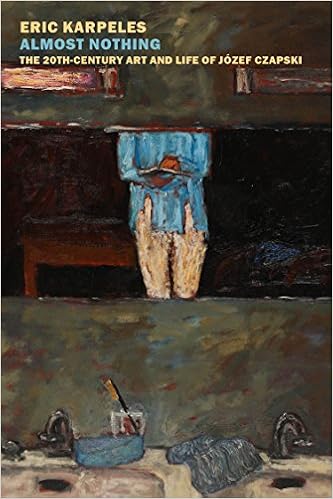
Almost Nothing: The 20th-Century Art and Life of Józef Czapski, by Eric Karpeles

Free Download Almost Nothing: The 20th-Century Art and Life of Józef Czapski, by Eric Karpeles
Almost Nothing: The 20th-Century Art And Life Of Józef Czapski, By Eric Karpeles. Accompany us to be member here. This is the web site that will provide you reduce of browsing book Almost Nothing: The 20th-Century Art And Life Of Józef Czapski, By Eric Karpeles to review. This is not as the other site; guides will certainly remain in the forms of soft data. What advantages of you to be member of this site? Get hundred compilations of book connect to download and also obtain always updated book each day. As one of the books we will certainly provide to you now is the Almost Nothing: The 20th-Century Art And Life Of Józef Czapski, By Eric Karpeles that features an extremely completely satisfied idea.
The presence of this Almost Nothing: The 20th-Century Art And Life Of Józef Czapski, By Eric Karpeles in this globe includes the collection of a lot of wanted publication. Also as the old or new book, publication will certainly provide outstanding benefits. Unless you do not really feel to be burnt out each time you open up guide and read it. Actually, book is an extremely fantastic media for you to appreciate this life, to appreciate the world, and to recognize whatever on the planet.
Also this publication is made in soft file forms; you could enjoy reading by obtaining the documents in your laptop computer, computer device, and also device. Nowadays, reading does not come to be a traditional task to do by specific individuals. Many individuals from lots of areas are always beginning to review in the morning as well as every spare time. It shows that people currently have big curiosity and have big spirit to review. In addition, when Almost Nothing: The 20th-Century Art And Life Of Józef Czapski, By Eric Karpeles is published, it becomes a most needed book to buy.
Well, when else will you discover this prospect to get this book Almost Nothing: The 20th-Century Art And Life Of Józef Czapski, By Eric Karpeles soft data? This is your great chance to be below and also get this fantastic book Almost Nothing: The 20th-Century Art And Life Of Józef Czapski, By Eric Karpeles Never ever leave this book prior to downloading this soft data of Almost Nothing: The 20th-Century Art And Life Of Józef Czapski, By Eric Karpeles in web link that we give. Almost Nothing: The 20th-Century Art And Life Of Józef Czapski, By Eric Karpeles will truly make a good deal to be your best friend in your lonely. It will certainly be the very best partner to boost your company and leisure activity.
Review
"This absorbing biography aims to rekindle interest in the Polish painter and writer Józef Czapski (1896-1993), whose career was for decades stymied by history's tumult. As a Soviet prisoner of war, he gave lectures on Proust and wrote a history of French painting, and, in 1940, was one of only a few hundred survivors of the Katyn massacre, in which twenty-two thousand Polish officers were killed. After the war, exiled in Paris, he advocated for a free Poland and wrote two searing memoirs, but only in old age was he able to devote himself to his paintings, which Karpeles analyzes with acuity and grace. Czapski call painting both "prayer" and "defeat," after a lifelong "apprenticeship of learning." --The New Yorker
Read more
About the Author
Eric Karpeles is a painter, writer, and translator. His comprehensive guide, Paintings in Proust, considers the intersection of literary and visual aesthetics in the work of the great French novelist. He has written about the paintings of the poet Elizabeth Bishop and about the end of life as seen through the works of Emily Dickinson, Gustav Mahler, and Mark Rothko. The painter of The Sanctuary and of the Mary and Laurance Rockefeller Chapel, he is the also the translator of Józef Czapski’s Lost Time: Lectures on Proust in a Soviet Prison Camp and Lorenza Foschini’s Proust’s Overcoat. He lives in Northern California.
Read more
Product details
Paperback: 496 pages
Publisher: New York Review Books (November 6, 2018)
Language: English
ISBN-10: 1681372843
ISBN-13: 978-1681372846
Product Dimensions:
6 x 1 x 9 inches
Shipping Weight: 1.6 pounds (View shipping rates and policies)
Average Customer Review:
5.0 out of 5 stars
2 customer reviews
Amazon Best Sellers Rank:
#93,078 in Books (See Top 100 in Books)
Józef Czapski is a well-known -- yet not very profoundly -- figure in Poland. His account of imprisonment in Soviet camps and his wartime search for the twenty thousand murdered comrades, collected in "Inhuman Land" and "Memories from Starobielsk" (both forthcoming from NYRB), from banned books have gained the status of required reading. Yet Czapski was much more than a survivor. Like Proust, whose writings became his life companion, Czapski was above all an artist of great sensibility, registering with keen perceptiveness minute changes in the quality of light that fell across objects as well as fine expressions of human face and body that often speak to their true feelings or hidden motives. Trained to be a painter in Paris between the wars, Czapski was thrust into history against his will, but never recoiled before the encounter. The first uniform he wore was that of Tsar's guards. Then he fought on the Polish side in 1920 against the Bolsheviks. In 1939 he joined the Polish army again, as an officer, with the intention to fight the Germans, but instead found himself facing a surprise attack of the Soviets on the Eastern front, near Lvov. Captured, along with thousands of others, he was among the 395 (and just over seventy from his camp) who survived the Katyn massacre. The disappearance of these tens of thousands Polish officers, Czapski's comrades, was not known until Germany had attacked Russia and, in desperate need of fighting forces, Stalin issued an "amnesty" to Poles caught in the enormous web of Soviet gulags. A river of migrants -- both soldiers and civilians -- flowed to the banks of the Caspian sea where General Anders was gathering his army. The breadth of Karpeles's historical research is impressive, but perhaps more importantly, an artist himself, he is able to present his subject with great feeling, yet without unnecessary sentimentalism. The pages describing Czapski's search, in 1942, for the missing officers are probably among the most moving in the book: even while we know the outcome of that search, we cannot help but be swept by the slightest hope that Czapski might be successful. As a historian, Karpeles has a well-honed sense of the present moment: that is, of that moment in the past as experienced by those who lived it, knowing what they knew and what was unavailable to them at the time. He is also closely tuned in to the changes in historical perception: for example, something that might come as a shock, the early and staunch support for Stalin in the West -- to the point that anything critical of his regime was immediately censored (e.g. on his early fundraising trip to America to gather support for the emigrant cultural/political publication "Kultura" in Paris, Czapski was explicitly forbidden from mentioning Katyn; similarly, in France, copies of his "Souvenirs de Starobielsk," published with the support of de Gaulle and other well-placed figures, against the popular communist condemnation, were being bought out by the French Communist Party and burned...). At times, Karpeles's book reads like a political/historical thriller. At others, Karpeles taps into the shared fascination with Proust whose work and life provide a canvas against which Czapski's own development and sensibility come into focus. As a painter, Karpeles can be critical of Czapski's creative output and able to appreciate both his failures and the moments of brilliance and inspiration obtained in Czapski's dogged pursuit of his craft. For a figure like Czapski, an artist, a diarist and a writer on topics as varied as history, painting, literature, politics, a self-professed Polish patriot and a lover of Polish culture, yet critical of narrowly conceived "patriotism" and opposed to any form of calcified nationalism or Catholicism (dominant in the country then as it is now!), at home in French as in Polish, Russian, and German (German was the language of tenderness between him and his mother), it is a great stroke of luck, or maybe fate, to have a biographer who is equally sensible to nuance, discerning in politics, and capable of navigating often hostile waters. Czapski's story is thus also interwoven with, no less fascinating, narrative of Karpeles's research. Not at all self-centered, this added perspective bridges the past and the present, allowing the reader to view the contemporary world through the artist's lens. Not hampered by the sort of self-censorship that haunts writing in Poland today, Karpeles is able to explore Czapski's sexuality, his inner conflicts, his religiosity, with an uninhibited simplicity. We thus get a full portrait of a complex character who, above all, remained true to himself throughout his life.
Probably one of the most beautiful books I've read. It is not only biography of the painter, writer and unbelievable historical figure (what a richness of life!!!), but the book about the artist written by the artist, the model for writing about someones life. It is not only fascinating combination of facts (which indeed are extremaly interesting in Czapski life - from russian Tzsar, to Stalin, Soviet camp and parisian "golden time" of Proust, Picasso, Diaghilev etc.), but first of all it is the book about finding the substance of life, substance of painting. This book gives the reader a breath of understanding what is art and what is life. It is also the biography of entire 20th century - it shows its beauty, level of complication, darkness and pain.It is important biography, and work of art istelf, piece of an outstanding prose of the 21st century.
Almost Nothing: The 20th-Century Art and Life of Józef Czapski, by Eric Karpeles PDF
Almost Nothing: The 20th-Century Art and Life of Józef Czapski, by Eric Karpeles EPub
Almost Nothing: The 20th-Century Art and Life of Józef Czapski, by Eric Karpeles Doc
Almost Nothing: The 20th-Century Art and Life of Józef Czapski, by Eric Karpeles iBooks
Almost Nothing: The 20th-Century Art and Life of Józef Czapski, by Eric Karpeles rtf
Almost Nothing: The 20th-Century Art and Life of Józef Czapski, by Eric Karpeles Mobipocket
Almost Nothing: The 20th-Century Art and Life of Józef Czapski, by Eric Karpeles Kindle


0 komentar:
Posting Komentar